

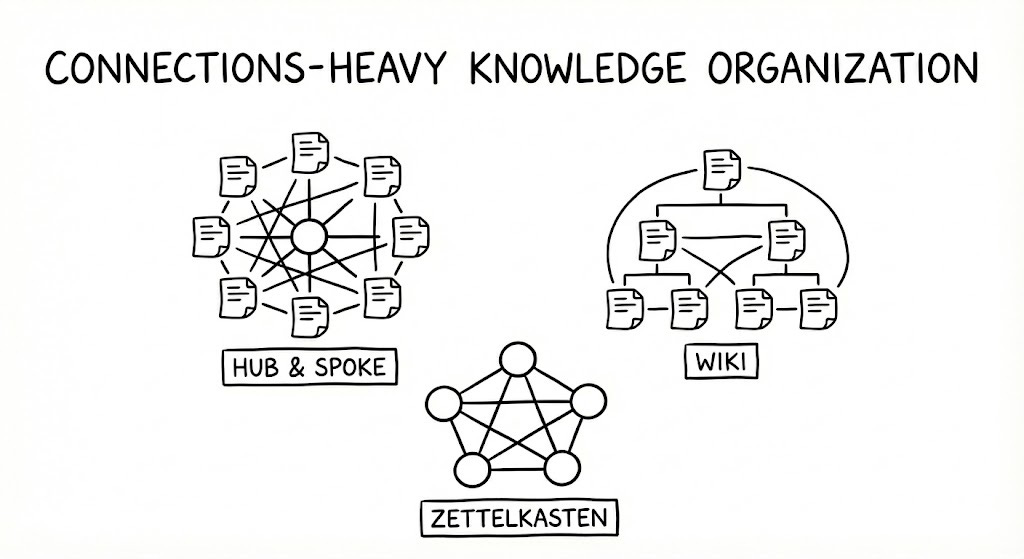
You’ve rebuilt your note system three times this year. You watched the Zettelkasten tutorials, set up the daily notes, and created the folder hierarchy someone on Reddit swore by. And somehow your notes still feel like a junk drawer you’re afraid to open.
Most people think they have “a note‑taking problem.” In reality, they have a structural mismatch: they’re trying to grow a jungle of ideas inside a filing cabinet… or run a lab as if it were a library.
The fix isn’t more discipline: it’s seeing what actually works for people who think as you do. Public digital gardens give us something rare: a peek at personal knowledge organization systems in the wild.
Maggie Appleton, designer and visual thinker, writes about digital gardens as “a different way of thinking about our online behavior around information.”
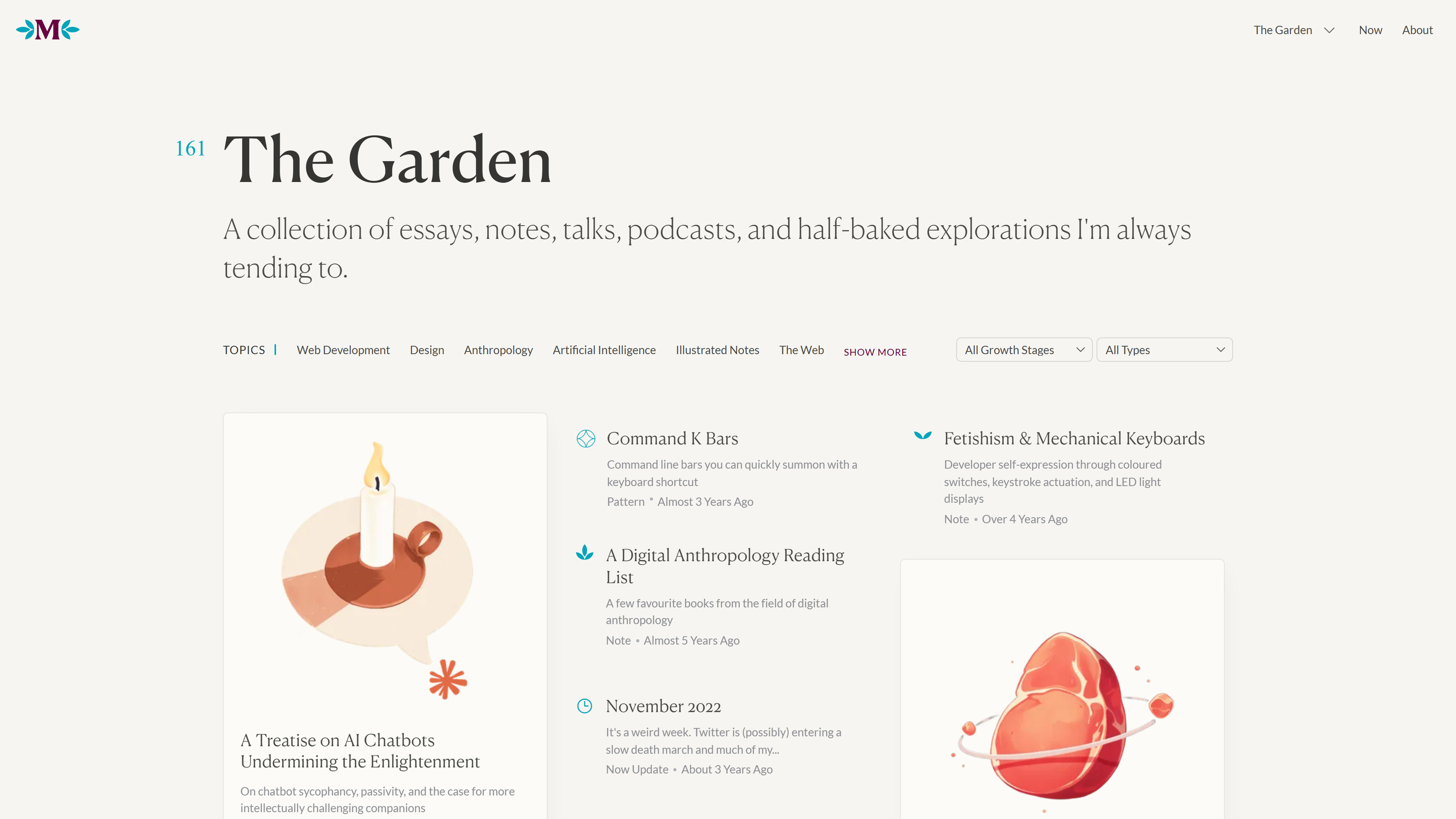
Her garden looks nothing like Simon Willison’s rapid-fire technical discoveries,
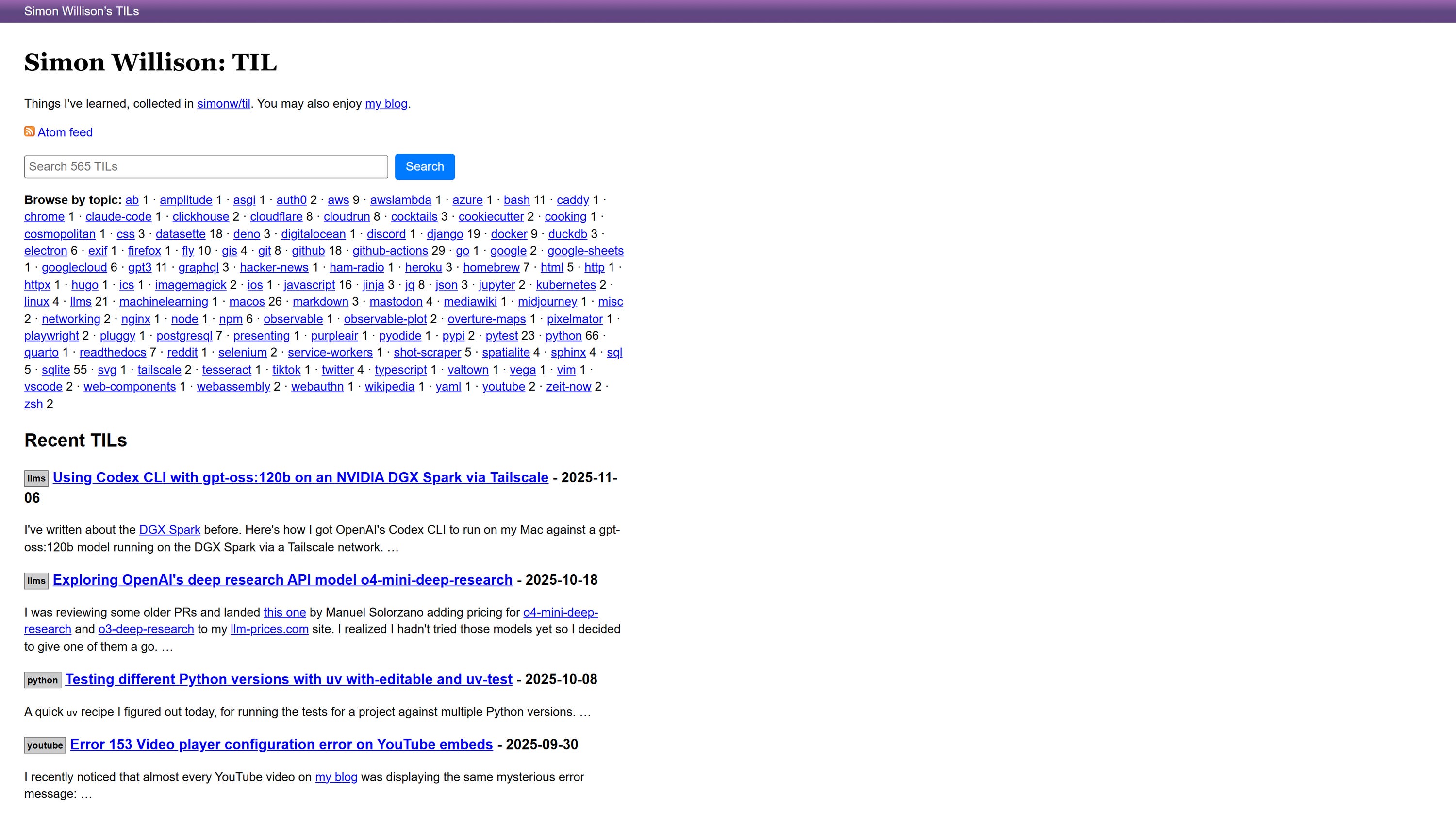
which looks nothing like Nikita Voloboev’s sprawling personal wiki.
They’re all “digital/knowledge gardens”, but they serve completely different knowledge work styles.
That’s why I’ve decided to gather and analyze the database of public Digital Gardens. One question drove the analysis: Which personal knowledge organization structures actually work and for whom? The answer isn’t one system. It’s four distinct styles.
Why it matters
When you understand your style of knowledge work better and stop fighting your tools, three shifts happen:
Simplicity: You stop agonizing over metadata. If you’re a Journaler, you just need the date. If you’re a Networker, you just need the connection.
Findability: Your notes become retrievable because they are organized the way your brain searches, not how a YouTuber’s brain searches.
Sustainability: You build a foundation that matches your actual output, not an idealized workflow you can’t maintain. You stop copying random setups from YouTube and start coping with your own constraints instead.
Myth: Master Zettelkasten (or whatever’s trending now) to become a great note-taker and knowledge worker.
Better Option: The structure should emerge from how you actually think, not from someone else’s system. Identify your knowledge work style → Select the model that serves it → Adapt tools to that pattern.
Evidence
When your external tools (graphs, lists, timelines) match your internal mental model, your brain stops wasting energy “translating” the tool and focuses on the work. Foundational research on cognitive fit shows that information systems aligned with user mental models significantly improve task performance and reduce cognitive load. Vessey & Galletta, 1991
Use / Avoid
Use when: You are starting fresh, rebuilding a vault, or feeling high friction with your current system.
Avoid when: You want a rigid prescription. Most successful knowledge workers eventually blend 2-3 of these styles together.
The Four Notes and Knowledge Organization Styles
After analyzing 100+ public digital gardens for their structure and navigation patterns, I’ve selected four dominant types.
Networkers build webs of connected ideas.
Chronologicals let time do the filing.
Curators collect and organize external resources.
Makers structure everything around output.
The four styles aren’t personality types; they’re structural patterns that serve different kinds of knowledge work. Most people lean toward one primary style with a secondary influence. The goal isn’t to pick a perfect label, but to notice which pattern your best work naturally gravitates toward. I’ll walk through each style in depth over the next few editions, starting with the one I see most often misunderstood: the Networkers.
🕸️ The Networkers (Connections-Heavy Organization)
The Philosophy: You think in connections… You don’t read linearly. You find yourself jumping across 3–4 tabs to chase an idea, leaving a trail of open windows behind you. Your best insights come from seeing how ideas from different domains relate. You’d rather link than file and trade tidy categories for dense, idea-level connections. You want to turn your notes into a thinking environment, not just a storage unit.
Great for:
Deep, multi-year explorations: research, frameworks, complex projects.
System thinkers, researchers, and creators who want to explore complexity and interconnectedness.
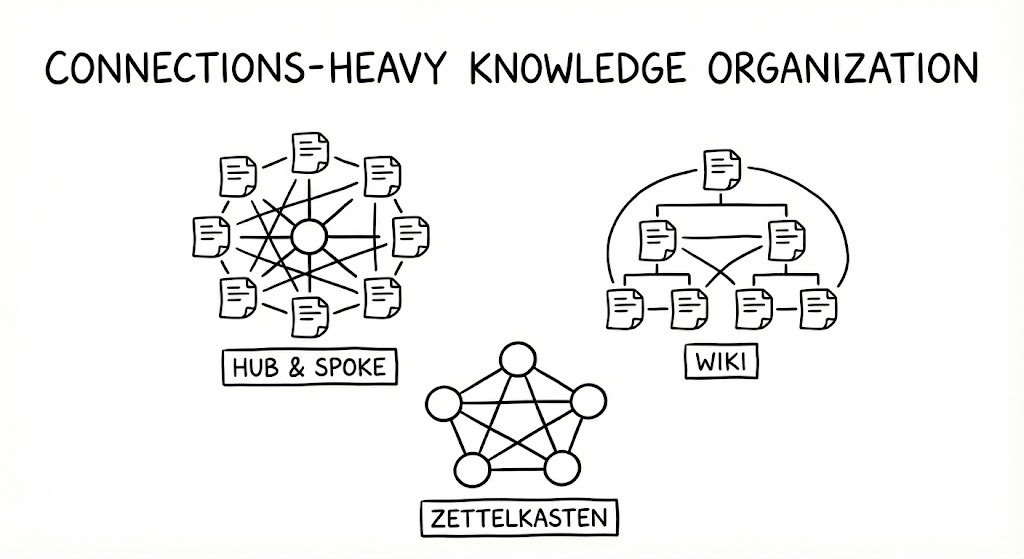
Zettelkasten Style. A decentralized web of atomic ideas linked by context rather than category.
Key traits:
Atomic notes (one concept each). Notes are small, personal, and evolving.
Heavy interlinking.
Folders are minimal and secondary to links: connections emerge from context, not from a preset taxonomy.
The Vibe: Organic, emergent, “bottom-up.”
Best Examples:
→ Andy Matuschak’s Working Notes — Nearly “classical” modern Zettelkasten-style notes.
→ Jerry’s Brain — A massive mind map focused on emergent connections.The best visual “Zettelkasten-style” realization I’ve seen.
→ Gordon Brander’s Patterns — Atomic entries with heavy tagging across systems thinking, futures, and strategy.
Wiki / Encyclopedia Style. A comprehensive resource designed for objective fact-finding and definitions.
Key traits:
Top‑down topic pages.
Factual, reference-oriented tone
Great for “what is X?” lookups.
The Vibe: Structured, objective, “top-down.”
Best Examples:
→ Nikita Voloboev’s Wiki — Huge, fast, with topic graph. The classic personal wiki and a perfect rabbit hole.
→ Matouš Dzivjak’s Wiki — Traditional wiki structure showing how to organize different knowledge areas.
Hub & Spoke Style. A guided exploration where central pages act as launchpads.
Key traits:
Central “Map of Content” pages branch to specific notes.
Guided exploration. Unlike Zettelkasten, this offers clear pathways for the reader.
Hierarchical branching (Often 1–2 levels deep:
Area → sub‑topic → notes.)The Vibe: Curated, guided, “middle-out.”
Best Examples:
→ Paul Copplestone’s Knowledge Garden — Great MOC examples showing work in progress.
→ David Gasquez’s Handbook — Engineering notes and personal systems made approachable.
💎 Networkers build knowledge like constellations—the meaning lives in the connections, not the individual stars.
👉 You are probably a Networker if: You often say “That reminds me of...” while reading unrelated topics, and you feel uneasy when you have to force a note into a single folder.
Topics: Knowledge Management
Sources:
But not everyone thinks in webs. Some people think in projects, and for them, the work itself is the organizing principle.
Next up: The Creators & Makers. Lab notebooks, evergreens, portfolio gardens, and why your projects might be the only filing system you need.
—Elle