

The tech industry says move fast, don't look back. Meanwhile, a guy sat down with his grandmother and built a personal encyclopedia. A gardener voice-dictates proposals from his truck. A researcher turned his journals into a wiki that talks back to him. None of them optimized for scale. All of them built something that fits.
Marc Andreessen says introspection is a “Viennese pathology”, designed to induce guilt. The right move is always “move forward. Go.” JA Westenberg responded: “Forward toward what?”
It’s not a rhetorical question. Westenberg traces a line from that philosophy to social media platforms built by people “treating behavioral data as substitute for understanding human psychology.” The measure became the target, and as Westenberg put it, “the target was not what anyone would have chosen.” (I wrote about this problem earlier — it’s not new, but Westenberg names it better than anyone.)
But I’ve found that while the platforms keep A/B testing engagement metrics and optimizing for numbers no one chose, something different is happening at the individual level. People are building their own tools to understand themselves — who they are, what they need, and how they think. Maggie Appleton calls this kind of building “home-cooked software” — building on Robin Sloan’s 2020 essay about an app he built for four users: his family. Sloan’s description: “When you liberate programming from the requirement to be professional and scalable, it becomes a different activity altogether.”
Appleton’s term for the builders is “barefoot developers” — teachers building Notion systems, students creating dashboards, people embedded in their communities who understand local problems that no company will ever solve. Simple, cheap, user-controlled, private, purpose-built. “It solves local problems for local people.”
So: what does local, home-cooked introspection look like? It operates at every scale. Each layer goes deeper:
Who am I? Where do I come from? — introspection into your family, origins, and identity.
What do I actually need? What fits me? — introspection into your daily work and learning.
How do I think? What do I actually believe? — introspection into your own thinking process.
1. The intimate builders
Jeremy Philemon started with 1,351 loose family photos in his grandmother’s cupboard. He sat down with her, asked her to reorder the wedding photos, and wrote everything down as she narrated stories she’d never told anyone. That became whoami.wiki — an open-source personal encyclopedia built with MediaWiki and Claude Code.
Jeremy also pointed Claude Code at 625 photos from a 2012 family trip, and the model started finding things he’d forgotten. Locations identified from photos alone. Bank transactions cross-referenced with location data to surface restaurants they’d visited. A Ticketmaster invoice that named the teams playing at a soccer match visible in his photos. Then it wove a decade of friendships through 100k WhatsApp messages into pages “that read like it was written by someone who knew us both.” The tech is real. But his summary tells you what it’s for: “The encyclopedia didn’t just organize my data, it made me pay closer attention to the people in my life.”
This HN thread filled with people already building their own archives and encyclopedias. Someone created an email address for his newborn son and sends him messages, photos, stories, asking family members to do the same:
“I’m imagining him looking through his email when he’s 18 and reading personalized messages sent by family members who might no longer be with us then.”
Just a parent with one email address and eighteen years ahead of him, who wants his son to know the people who loved him.
💎 The first layer of introspection is about the people and their stories who shaped you.
2. The barefoot builders
You’ve downloaded apps built for millions of people and wondered why none of them fit the way you actually work. A maintenance gardener, a family caretaker, and a writer all built custom AI systems, and none of them started as developers, yet all built for a user base of one.
piazz built a family agent stack: a calorie tracker, a Japanese tutor, a family tech-support bot, and proactive reminders for loved ones with negative cognitive patterns. That last one is worth sitting with — you can’t build proactive reminders for someone’s cognitive patterns without first understanding that person. This is software built for the people you eat dinner with, shaped by what you know about them that no product team ever could.
mjsweet is a maintenance gardener who voice-dictates from his truck, then an agent analyzes site photos and generates a polished 14-page proposal. Twenty minutes, high conversion. He built this because no existing app serves maintenance gardeners — and because he understood exactly how he works: from a truck, between jobs, thinking out loud. He published the code.
And borski built a writing skill called Bobby, configured with a detailed description of exactly how he writes, set to challenge him rather than flatter. When the AI knows your voice well enough to push back on your weak sentences, you’ve built something Grammarly never will.
💎These builders aren’t a future trend. They’re already here, and every one of them started the same way: by understanding their own needs well enough to know that no existing tool would do.
These builders introspected into their work, their relationships, and their learning. But what happens when you turn the lens further inward — toward how you think?
3. The inward builders
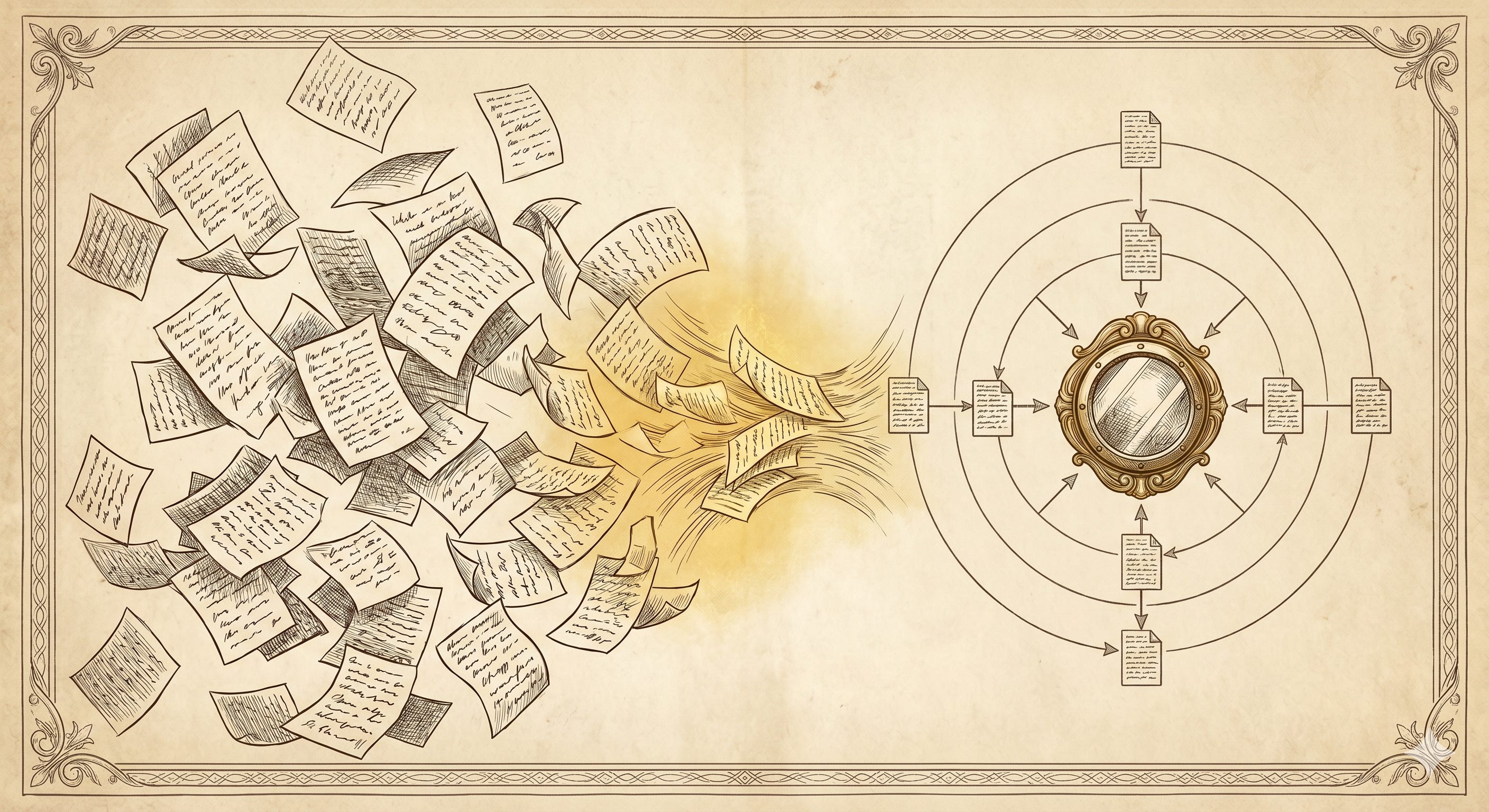
Andrej Karpathy’s LLM Wiki pattern starts from a simple observation: most people use AI the same way every time: upload a document, ask a question, get an answer. In the next session, the AI has forgotten everything. You start from zero again. His alternative: the LLM incrementally builds and maintains a persistent wiki — “a persistent, compounding artifact” that gets richer with every source you add and every question you ask. Karpathy built this for research: analyzing papers, articles, and reports. But for me, as for the “wannabe barefoot developer”, the most interesting application is one he names almost in passing: “tracking your own goals, health, psychology, self-improvement — filing journal entries, articles, podcast notes, and building up a structured picture of yourself over time.”
The architecture is simple. Raw sources go in. The LLM reads them, extracts what matters, and integrates it into a wiki, updating entity pages, flagging contradictions, and strengthening the evolving synthesis. The human’s job: “curate sources, direct the analysis, ask good questions, and think about what it all means. The LLM’s job is everything else.” The wiki is just a folder with text files you control. Nothing leaves your machine.
But what if the “raw sources” you point it at aren’t research papers, but your own journals, decision logs, literature notes, and half-formed ideas? Your originals stay intact in the source folder — nothing gets overwritten, nothing gets lost. The wiki is a separate layer: analysis that accumulates on top of what you’ve already written and thought. Not a replacement for your notes. An additional lens on them — one that finds patterns you missed, flags contradictions you glossed over, and builds connections across years of your own thinking.
What if the wiki becomes not a research database but an introspection database?
Not tools that think for you — tools that push you into thinking. (The difference matters: introspection asks, “What should I do next?” Rumination asks, “Why did I fail?” Same wiki, different question.) Each one adds a different layer of analysis to what you already know about yourself.
Boris Cherny suggests a simple challenge: tell Claude “grill me on this and don’t move forward until I pass your test.” Instead of you prompting AI to produce something, AI prompts you — asking deeper and deeper questions about your idea before you start building. By question #20, you realize you missed something obvious. The value isn’t the output afterward — it’s what you discover about your own thinking while answering. (The same approach works for decisions, not just code: “prove to me this is the right direction” turns a wiki of your own notes into a sparring partner.)
And there are more layers you can add. Each one changes what your personal wiki can do:
Your wiki surprises you — eleveriven on the whoami.wiki thread:
“Normally, memory work is you pulling things out of your mind. Here, it’s the system pushing things back at you.”
Not a database you search, but a system that surfaces what you’ve forgotten. Your journals from three years ago, cross-referenced with this week’s decisions — without you asking.
Your wiki thinks while you sleep — Nick Lawson’s Memory Agent adds a scheduled pass across your notes, finding patterns you haven’t noticed. A lightweight database, two tables, three AI agents. The wiki gets smarter overnight. Free on GitHub, wired to Obsidian. Repo.
And then it acts on what it finds — Boris Cherny’s audit-then-fix pattern: after running any analysis (gaps, contradictions, stale claims), have the agent apply the fixes in the same session. Eliminates the “I have insights but never act on them” gap.
It turns out the wiki can become an introspection database the moment you point it at your own journals and add tools that ask you better questions than you’d ask yourself. Westenberg’s “forward toward what?” is still the test — but now you have infrastructure that helps you answer it.
The Shift
None of the builders in this edition is anti-Andreessen. They ARE moving forward. Jeremy shipped whoami.wiki. Mjsweet sends proposals from his truck. Karpathy’s wiki pattern is already spreading. They’re building, shipping, iterating — doing exactly what “move forward, go” demands.
The difference is that they stopped long enough to ask Westenberg’s question first.
The intimate builders asked, “Who am I building this for?” — and the answer was a grandmother, a child, a household. Not a market.
The barefoot builders asked, “What do I actually need?” — and the answer was specific enough that no existing product could satisfy it.
The inward builders asked, “How do I think?” — and built infrastructure that compounds their self-understanding instead of replacing it.
The platforms that skipped introspection ended up optimizing for what’s profitable to measure: engagement, time-on-screen, click-through, not what actually helps the people being measured. The solo builders who started with introspection built something that actually fits.
Introspection isn’t the opposite of action. It’s the prerequisite for action that matters.
—Elle
P.S. Westenberg wrote that "human inner life is where the question of whether a life is going well actually gets answered." The people in this edition answered that question by building — not for a market, but for a grandmother, a family member or themselves. You probably already know what you'd build. You just haven't asked yourself the right question yet.