

Topics: Personal Knowledge Management, Learning & Memory
In Part 1: Journals for Time-Travelers, we explored journaling as "thinking made visible." But what if introspection isn’t your thing? You just want to stop losing the lessons you paid for with time and effort.
That’s where the TIL stream comes in.
💡The TIL (Today I Learned) Stream
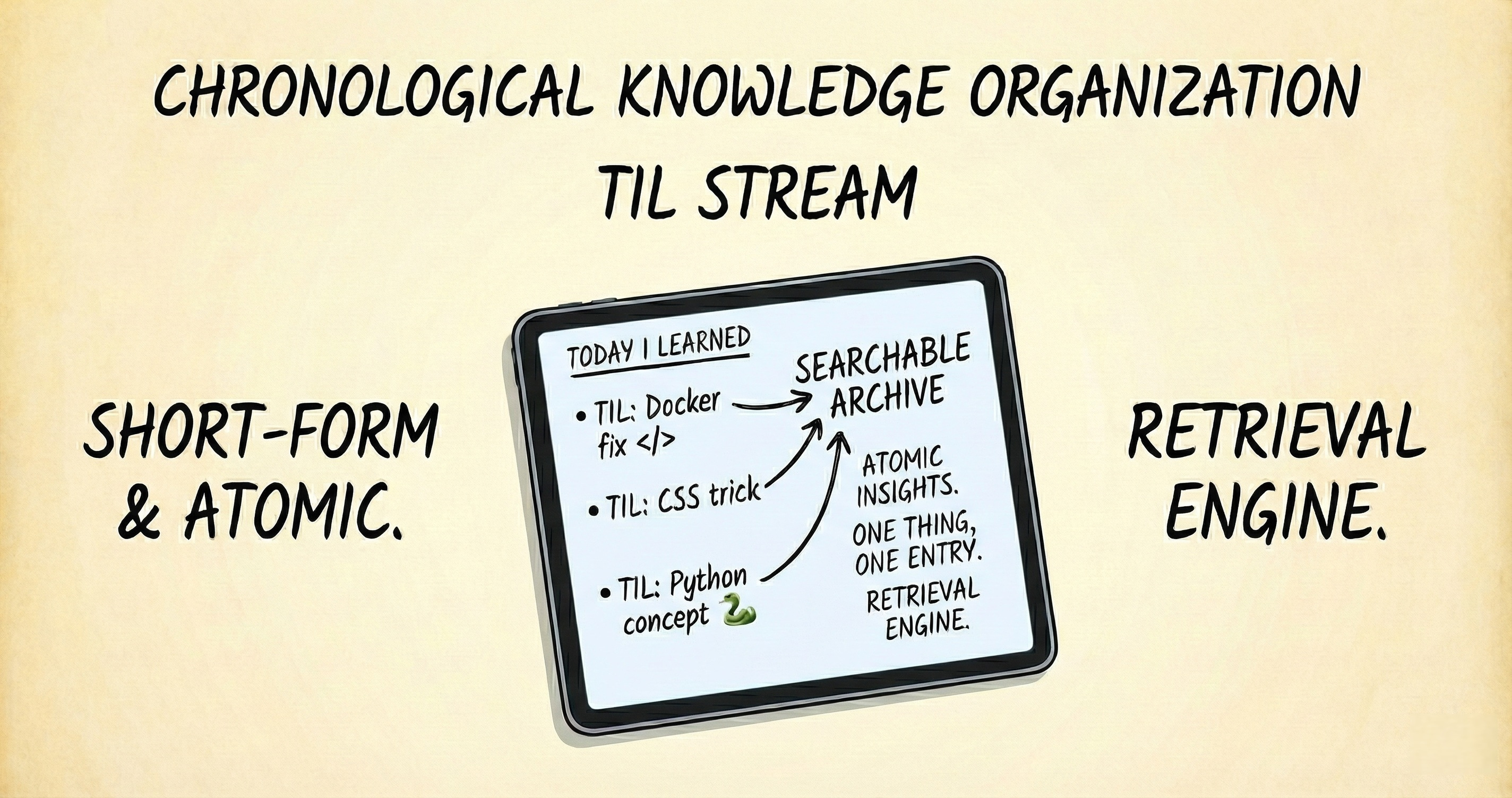
A TIL stream is a rapid-fire feed of short discoveries: snippets, quick wins, small "aha" moments, timestamped and searchable.
Unlike a journal (which is about you), a TIL stream is about what you solved. Each entry captures one thing: a command that worked, a concept that clicked, a trick worth remembering.
No reflection. No narrative arc. Just learnings, logged before they evaporate.
This is journaling stripped to its most useful core: retrieval. Every entry teaches something specific to you, and to anyone else who stumbles across it.
The original TIL practitioner? Thomas Edison. He filled over five million pages with experiment logs, not essays, but problem-solution pairs. Every attempt, every failure, every lesson. When something finally worked, he’d revisit old entries and apply fresh insights to stalled problems.
The format has changed. The practice hasn’t.
Key Traits
Short-form and atomic. One insight per entry. A paragraph, a code snippet, a link with context. That’s it.
Chronological but searchable. Date is the default organizer; tags and categories emerge naturally over time.
Technical or practical focus. Common among developers, but works for any skill-based learning: design, writing, cooking, parenting, whatever.
The vibe: A workbench with labeled drawers. “Here’s the trick.” “Here’s the command.” “Here’s what broke.” “Here’s the fix.” Less Dear Diary, more Note to Future Me (who will definitely forget this by Friday).
What TIL Streams Are For
Learning by explaining. Writing a TIL forces you to articulate the solution, not just what you encountered. Even if you’re only teaching a wall.
Building a personal search engine. We all have those moments: “I fixed this exact error last year... how?” A TIL stream is a retrieval system that quickly answers that question.
Tracking your learning trajectory. Over months and years, TILs reveal what you were curious about, what you were struggling with, and what you were mastering at each stage. Breadcrumbs through your own growth.
Making progress visible to others. Shared TILs are the lowest-effort way to build trust and reputation without writing “thought leadership essays” you secretly hate.
Examples to Explore
Want to see TIL streams in action? These are some of the best:
🔗 Simon Willison’s TIL — The gold standard. Daily technical discoveries across Python, SQLite, AI, and web development. Searchable by topic, updated constantly.
🔗 Brandur’s Fragments — Short, sharp engineering reflections from building production systems at Stripe and beyond.
🔗 Josh Branchaud’s TIL — Over 1,000 TILs organized by topic in a simple GitHub repo. Proof that the format scales.
Best Practices:
1. One entry, one insight. “Three things I learned about Docker” is three TILs, not one. Atomic entries are more searchable, more shareable, and easier to remember. Good title patterns: “How to ___”, “Fix ___”, “Why ___ happens”, “Recipe: ___”.
Research note: A systematic review defines microlearning as bite‑sized, targeted content for specific objectives. It reports positive impacts on learning outcomes across reviewed studies, providing strong evidence for the "atomic" note structure. From 📄 Microlearning beyond boundaries (Monib et al., 2025).
2. Capture immediately, polish minimally. The value is in the insight and the timestamp, not the prose. If writing takes longer than learning, you're overengineering. A rough note today beats a polished post never.
Research note: We lose ~50% of new information within an hour, up to 70% within 24 hours. Immediate capture is critical; polish can wait or never come at all. From 🔗 The Forgetting Curve (Ebbinghaus, 1885).
3. Add just enough context. Future-You needs to know why this mattered, not just what it was. One sentence of the problem you were solving and/or the project it related to prevents orphaned snippets that make no sense six months later.
Research note: Deeper semantic processing - understanding why something matters creates stronger, more durable memory traces than shallow surface-level encoding. Context is the glue. From 📄 Levels of Processing (Craik & Lockhart, 1972).
4. Include a minimum viable example. One snippet, one command, one screenshot - something you can copy, run, or recognize instantly. Abstract explanations fade. Concrete examples stick.
Research note: Learners who studied worked examples significantly outperformed those who solved problems on their own. A concrete, runnable example reduces cognitive load and accelerates understanding. From 🔗 The Worked Example Effect (Sweller & Cooper, 1985).
5. Make it a ritual. Spend 10–15 minutes at the end of your day writing down one thing you learned. Not when you "have time." Every day. The consistency matters more than the duration.
Research note: Researchers at Harvard Business School found that employees who spent 15 minutes daily reflecting on lessons learned performed 23% better than those who just kept working. Reflection isn't downtime, it's how learning consolidates. From 📄 Learning by Thinking (Di Stefano et al., 2014).
🧪 Try It Now: Write Your First TIL
15 Minutes: The Daily TIL Email
The easiest way to start a TIL practice? Email yourself.
Near the end of your day, ask: What did I learn today?
Maybe it’s a shortcut that saved you time. A mistake you won’t make again. A concept that finally clicked. A tool you discovered. A workaround that actually worked.
Write it down using this format:
TIL: [One-line summary]
[2–3 sentences of context: what problem you were solving, what you tried]
[The insight, command, or solution—something you can copy or recognize later]
[Optional: link to source, screenshot, or related note]
Then choose your mode:
🎮 Single-player: Send the email to yourself (or write it in a note, doc, or journal). One extra question: How can I turn this insight into action?
👥 Multiplayer: Post it somewhere others can see—Slack, social media, a newsletter. Tag at least one person who'd benefit.
More About TIL Streams
Want to go deeper? These essays shaped how people think about learning in public:
🔗 Learning in Public — Why sharing your learning as you go turns progress into a feedback loop (and makes it easier to keep going).
🔗 Do Not End the Week With Nothing — A gentle kick to ship *something* each week—an artifact, a note, a fix—so your work leaves tracks.
🔗 How to Remember What You Learn — A practical case for “learning by teaching”: explaining what you learned is a fast way to make it stick.
🔗 Today I Learned Subreddit — The original TIL community. Fun for trivia, but entertainment-first, not “future-me retrieval-first.”
💎 The TIL isn’t about documenting what you know. It’s about making what you learned findable for the version of you who’ll forget by next month.
—Elle
P.S. But what if quick captures aren’t enough? What if you’re drowning in bookmarks, articles, and resources, and need a system to actually organize them?
Next week: The Curators - when collecting isn’t the problem, but finding what you collected is.