

I’m always looking for two things when I curate information for this newsletter: the “why” behind the “what” and practical ways to turn information into action.
This week, I found both in a data engineering concept applied to personal knowledge management, in three vault teardowns that converged on the same architecture, and in a practitioner who analyzed 8,000 of his own AI conversations and discovered something uncomfortable about himself.
Improve Your Information Capturing Workflow
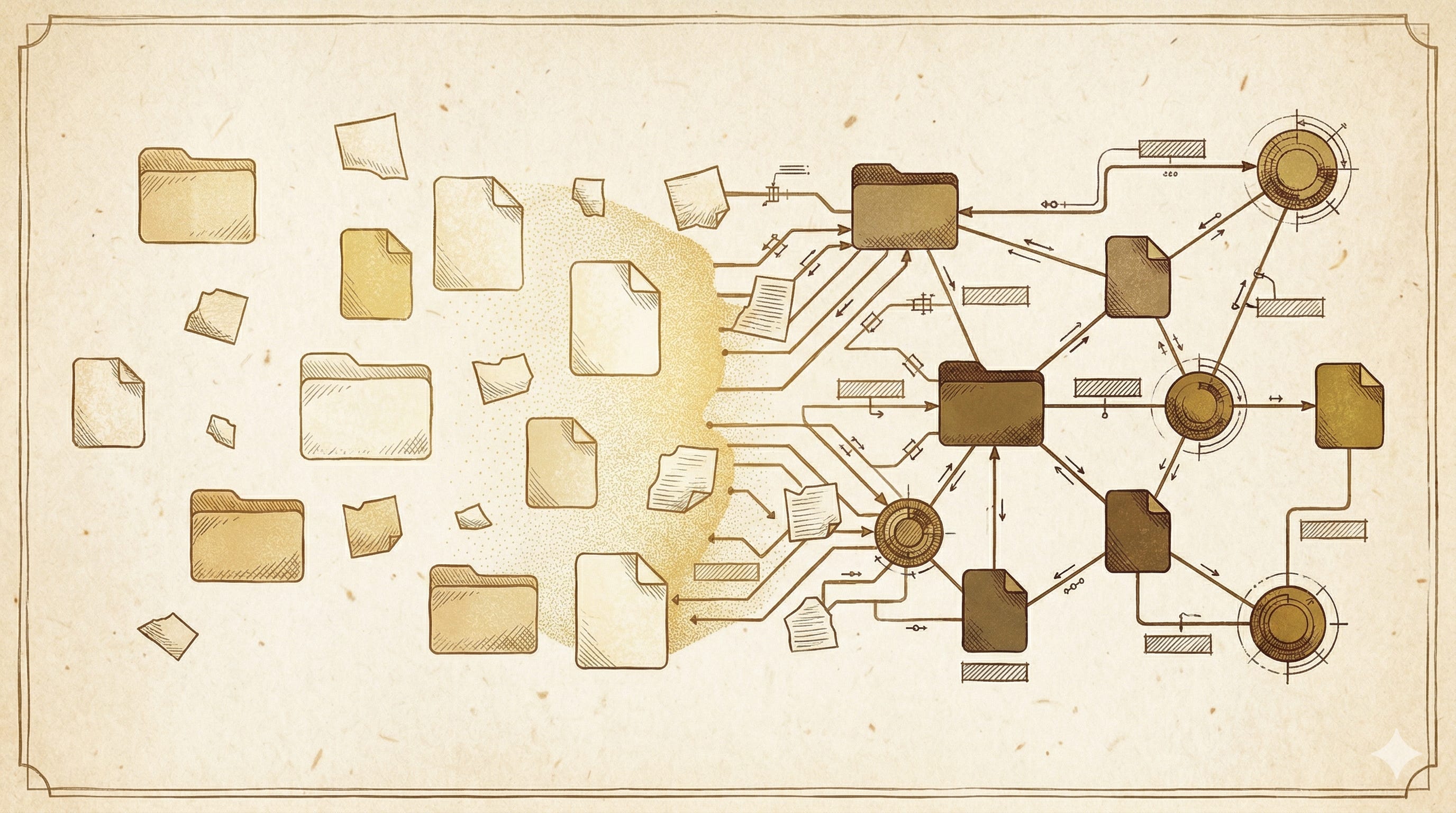
If you’re feeling brain fry and information overload (sources multiplying, reading lists growing, nothing sticking) — Christopher S. Penn processes roughly 500 articles per hour, and the concept that makes it work isn’t from productivity culture. It’s from data engineering: Extract, Transform, Load. You pull information from sources (Extract), clean and shape it into something meaningful (Transform), then put it to work (Load). 💎If your information intake feels broken, it’s broken at one of these three stages — and naming the stage makes the fix obvious.
Penn’s Extract is a priority funnel: important vendor announcements first via a Discord server (announcement channels only, everything else muted), then community reactions on Reddit (”that qualitative reaction tells you things a press release never will”), then deeper content like arXiv papers and conference proceedings. The idea: know which sources to check first, so you start with what matters most and stop when you’ve had enough. His Transform uses three buckets: is this a model update, a harness update (tools wrapping models — Cursor, Claude Code, Notion AI), or a practical use case? Once you name the bucket, you know what to do with it in the Load stage: think about how to implement it, test whether this harness update is worth it, or compare a practical use case with your workflows and solutions.
But ETL doesn’t have to be analytical. One Reddit commenter does something completely different at the Transform stage: they filter by how content makes them feel. Not topic tags, but emotional responses: #hope, #wakeup, #structure, #order. They said it led to connections they’d never have made otherwise:
“between learning how to make a better cup of coffee, a metaphor I found interesting in a book, and a philosophical quote I saw online.”
Same three-stage architecture, entirely different classification logic — and both work.
If you want to go beyond manual sorting entirely, the open-source Horizon repo (866★, MIT) is a starting point: Fetch → Deduplicate → AI Score → Filter → Enrich → Summarize → Deploy.
Additional tools to consolidate your Extract stage: Obsidian RSS Dashboard (RSS + YouTube + podcasts in one vault dashboard), Obsidian Web Clipper 1.0 (route different web pages into different note types automatically), and Raindrop Stella AI (ask questions across your saved bookmarks — turns a bookmark archive into a searchable knowledge base).
Design Your Knowledge Vault Around Your Actual Workflows, Not Popular Frameworks
Three practitioners recently published their vault architectures, and all three arrived at the same invisible infrastructure that none of them planned.
Tony Nguyen published both the template and the “anti-template,” documenting not just what he kept but also what he threw away and why. Daily notes? Gone (”hard to keep up the fragments — weekly notes allow for better lines of thought”). Centralized task inbox? Gone (”not useful without context — tasks live in project notes and weekly files”). What survived: a four-level structure (System → Shared → Personal → Work) driven by one weekly question:
“If I could only accomplish one thing this week, what would make everything else easier or unnecessary?”
David Minkovski built a file-based life OS with Obsidian as the interface, Claude Code as the operator via CLAUDE.md, and Git for version control (”time travel for your thinking”). His sharpest insight:
“Chats aren’t knowledge. They’re interactions. You can’t build a system on interactions.”
Internet Vin adds a design choice worth sitting with: strict separation between what AI writes and what you write — so you always know which ideas are yours.
I tried Tony’s weekly rhythm myself: Sunday planning with One Thing + priorities linked to OKRs, daily captures, Friday review — and the selection hierarchy (risk first → unblock others → highest impact → enable team → prepare for future) is useful for breaking decision paralysis on planning mornings. As kepano (Obsidian CEO) put it: “Two kinds of tools: ones that force you to adapt to how they work, and ones that adapt to the way you work.”
💎Your vault is an operating system. CLAUDE.md is the instruction manual. The app (Obsidian, Notion, whatever) is just the runtime. And written-down conventions are the invisible infrastructure that makes the whole thing work for both you and your AI.
Additional Tools: Two ready-made starters if you want to skip the blank page, building your workflows with AI: obsidian-claude-pkm (AI + Git backups) and get-shit-done (agent-driven project scaffolding).
Connect Your Scattered Notes And Discover Patterns About Yourself You Couldn’t See From Inside
If you have notes scattered across Obsidian, conversations in ChatGPT, quick thoughts in Apple Notes — and suspect there are patterns in your own thinking you can’t see from inside the fragments, Tommaso Nervegna analyzed 8,000 of his own AI conversations and discovered he’d been building the same constraint into his work 30 times without realizing it. 💎You can’t see your own patterns from inside them — but 8,000 data points can. Connecting isn’t about finding others’ knowledge. It’s about discovering yourself at scale.
Tommaso imported his ChatGPT, Claude, and Apple Notes history into Obsidian, then structured everything using a Palantir-inspired ontology that separates things in the world (people, tools, projects) from documents about those things (conversations, notes, transcripts) — connected by typed relations that say not just “these are linked” but why: discusses, uses, depends_on. He vectorized the vault, ran auto-clustering, and found over a million potential relationships. The pattern he couldn’t see from inside any single tool: the “one-man-band problem,” consistently designing systems requiring himself as sole operator, only became visible when everything was connected. Full pipeline: ~75 min, $4-5 in API calls, every step documented.
He’s not alone. A Reddit user digitized 45 years of journal entries — 8,000+ pages from 1981 — and reported: “Amazing the patterns and connections I am making in my life!” A contractor on the same thread built a linked vault mapping client → project → task → code → people, moving from Notion to Obsidian specifically for local AI access. Different scales, different purposes, same architectural insight: relational linking at scale reveals what folders and tags hide.
Why does this matter beyond personal insight? As Heinrich (arscontexta) put it:
“Everything is a context problem. When people say AI can’t do real work, they’re saying they gave it bad context.”
A vault with typed relations becomes a context repository your AI agent can actually work with. The agent stops guessing about your situation and starts referencing your actual work.
If you recognized yourself in the Networkers archetype — the instinct to link ideas across domains rather than file them in folders — this is the infrastructure that makes that instinct scale.
Additional tools: You don’t need the full pipeline to start: export your ChatGPT history (Daria Cupareanu built a migration tool for exactly this), import into Obsidian, and start linking conversations to projects. Even two or three typed relations (uses, discusses, depends_on) will surface connections you didn’t know were there.
The Vault Linker plugin solves the multi-vault version — link and embed across vaults with standard [[wikilink]] syntax.
The Shift
Capture as a pipeline. Name the broken stage (Extract, Transform, or Load) and the fix becomes obvious.
Knowledge vault as an operating system. The practitioners whose systems stick write down their conventions, and those conventions serve AI as well as they serve the human.
Connection reveals identity. Linking at scale doesn’t just organize your past — it shows you patterns about yourself you can’t see from inside the fragments.
—Elle
P.S. Most of us have years of thinking scattered across tools we barely open anymore. Conversations with AI that disappeared after the session ended. Notes that sit in a graveyard we feel guilty about. But here’s what I find hopeful: the infrastructure to connect all of it is becoming copy-paste-ready. We don’t need to be engineers to build it. We just need to start asking different questions: “What is this connected to, and what does the pattern tell me?” The answers might surprise us.