

Topics: Decision-Making & Well-being, Personal Knowledge Management, Habit Formation & Behavior Design, Learning & Memory
Time isn’t linear. It has ripples and folds like smooth silk. It doubles back on itself... and if you know where to look, you can catch the future shimmering in the present.
But your notes? Your notes can be wonderfully, stubbornly linear. They can be a timeline. A trail. A Captain’s Log.
This is the next part of the 🔗 Knowledge Organization Styles series. Some people think in webs (🔗Networkers). Some think in outputs (🔗 Makers). Today, we meet The Chronologicals - people who organize by when first, and let “what it’s about” emerge later.
The Philosophy: Sediment over Structure
Here’s the thing about time: it’s the only metadata that the universe automatically assigns to your thoughts. You don’t have to tag a moment “2026.” It just is.
Chronological thinkers lean into this. They don’t organize by topic first. They capture by date and let themes emerge from the timeline. The daily entry isn’t overhead; it’s the atomic unit of the system.
Because the hardest question in knowledge management isn’t “What tool should I use?”
It’s: Where does this go?
And a time-based system answers that instantly: It goes on today’s page, so you can focus entirely on “What’s happening now?”
Da Vinci did this. He filled thousands of pages with sketches, grocery lists, and engineering schematics - all mixed together. Thomas Edison amassed five million pages of daily logs. They weren’t building “systems.” They were thinking on paper, one day at a time.
The Vibe: ”Flowing, autobiographical, low-friction. It feels less like a Library and more like a Captain’s Log. Your notes stack up like layers of sediment: small wins, bugs, questions, drafts, and decisions all mixed together. And it can look messy. But a messy system you maintain beats a beautiful one you abandon after two weeks.
Chronological Notes Organization Great For:
- People who ship or debug every day and need a constant feedback loop: engineers, writers, developers, designers, anyone living in iteration mode.
- Capturing personal story arcs: how ideas, roles, projects, or your thinking evolved.
- High-context work where you regularly ask, “Wait... why did we do it this way?” Timestamped logs make decisions retrievable without forcing everything into folder taxonomies
- Reflective practitioners who value journaling, reviews, and retrospectives as core to their knowledge work, not a nice-to-have.
- Practicing self-anthropology: studying your own patterns, beliefs, and behaviors with curiosity rather than judgment
The Risk
If you aren’t careful, this becomes a write-only graveyard. Dumping everything into a daily note without review creates an archive, not a tool. Writing about problems isn’t the same as solving them.
A journal needs a purpose: retrieval, pattern recognition, or synthesis, to earn its keep. Review isn’t a “nice to have.” It’s part of the system.
The Two Flavors of Time-Travel
I’ve noticed two distinct ways people use time as their primary axis. Most Chronologicals lean toward one, though they often blend:
1. Journal-Driven Knowledge Organization (this week) — today’s page holds your life + work.
2. TIL Streams (next week) — today’s page holds what you learned + fixed.
📓 The Journal-Driven Knowledge Organization
The Director’s Commentary of your life.
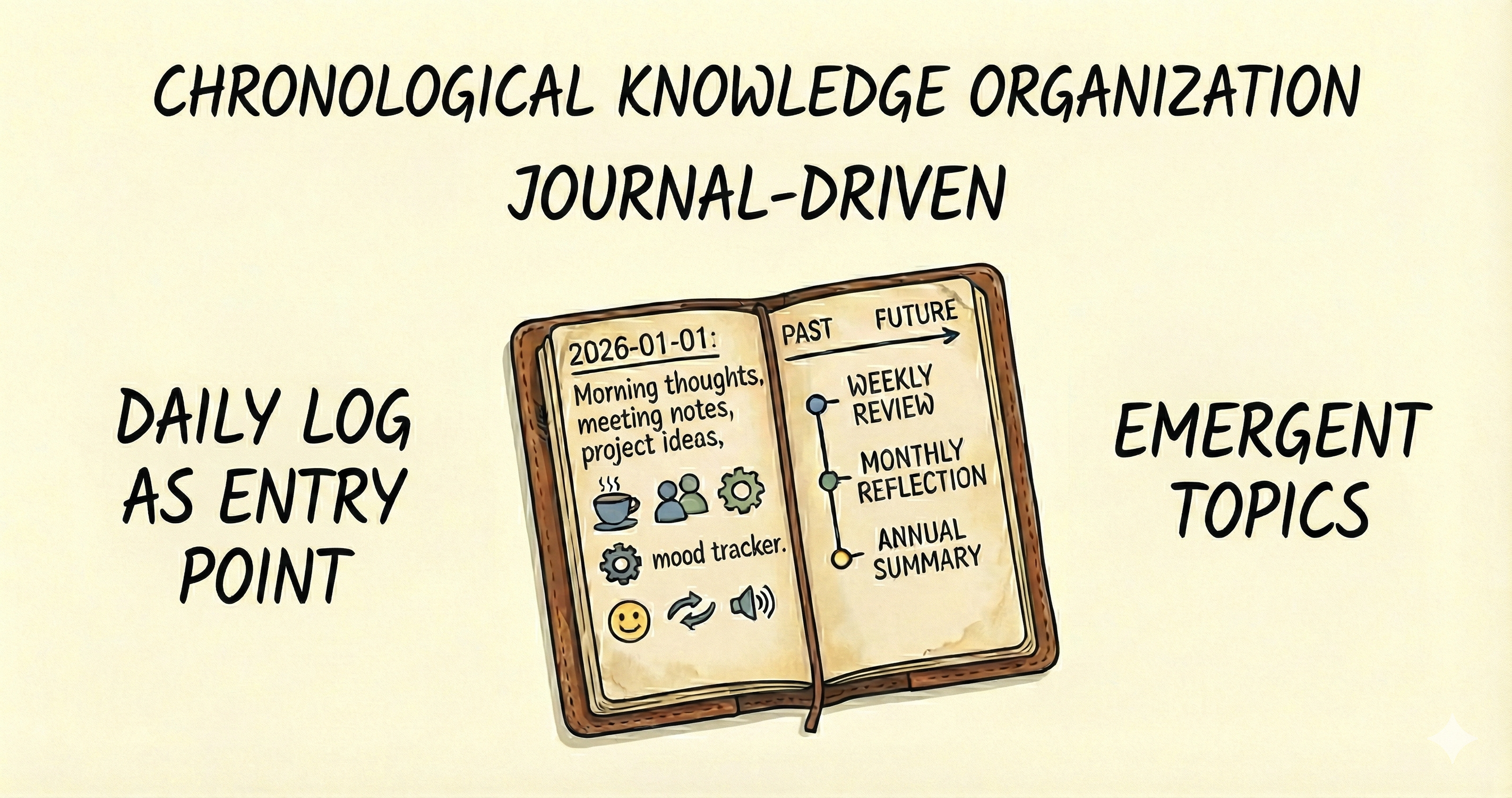
The premise is simple: today’s date is today’s note. Everything: tasks, thoughts, meeting notes, existential dread lives under a single timestamp. Topics don’t get folders. They get mentioned, linked, and allowed to emerge over time.
Unlike a private diary, a public journal lets others follow your thinking as it unfolds. You’re not performing insight. You’re leaving breadcrumbs for Future You and anyone curious enough to follow.
The payoff: context. Six months later, you won’t just find what you wrote, you’ll find the situation you were in when you wrote it. That’s the difference between remembering information and remembering meaning.
Key Traits:
- Daily notes as the entry point. The calendar is your navigation; folders are optional or absent.
-Emergent topics. Themes build themselves through repetition and backlinks.
- Reflective and informal. This isn’t polished publishing, but thinking on paper.
- Low friction. Capture first, organize later (or never).
Used For:
- Mental defragmentation: Clearing your RAM so you can actually think. Perfect for morning pages or brain dumps.
- Self-anthropology: Studying your own patterns and beliefs with the curiosity of a researcher, not the judgment of a critic.
- High-context work: When you need to know why you made a decision six months ago, not just what the decision was.
- Processing complex transitions: Career changes, health journeys, creative projects. Documenting as you go turns chaos into narrative
Examples to Explore:
- 🔗 Buster Benson’s Piles — A living “book of life” with chronological changelog and annual reviews.
- 🔗 Chinarut’s Brain Map — Autobiographical map of life events in TheBrain’s visual format.
- 🔗 Winnie Lim’s Journal — A masterclass in vulnerable, useful public journal.
Best Practices:
1. Journal with purpose, not obligation. Before you start, answer: What will I do with these entries? Weekly review for patterns? Monthly reflection for decisions? Annual summary for trajectory? If your only answer is “maybe I’ll look back someday,” this might not be your system.
Research note: 📄 Impact of Perceived Reward on Habit Formation (Judah et al., 2018). Pleasure and intrinsic motivation accelerate habit formation beyond mere repetition: habits stick faster when the behavior itself feels rewarding.
2. Decide your review rhythm before you start. Weekly skim. Monthly “what changed?” Annual “what did I become?” Schedule the retrospective before you begin the habit.
Research note: 📄The Science of Effective Learning (Carpenter, Pan, & Butler, 2022). Spacing and retrieval practice dramatically improve long-term retention, but only when review schedules are planned in advance.
3. Plug into existing rhythms. Don’t add journaling to your to-do list. Attach it to something you already do: morning coffee, end-of-day shutdown, weekly planning session. The best habit draws off an existing one.
Research note: 📄 Habits: A Repeat Performance (Neal, Wood, & Quinn, 2006). Habits are context-response associations triggered by cues. Experience-sampling studies show ~45% of daily behaviors are habitual repetitions in stable contexts.
4. Use low-friction structure. Tiny headings you reuse: Wins / Friction / Decisions / Questions. Nothing that turns journaling into form-filling.
Research note: 🔗 The Fogg Behavior Model (BJ Fogg). Behavior happens when Motivation, Ability, and Prompt converge. Increasing simplicity is more reliable than boosting motivation.
5. Use visual anchors. A photo, a color palette, a quick sketch can hold emotional context that paragraphs can’t. “On this day” images become searchable memories.
Research note: 📄 Personal Photographs & Memory (González et al. review) reporting that personal photographs used as memory prompts are associated with benefits like well-being, mood, and cognitive outcomes in studied contexts.
6. Standardize your dates. YYYY-MM-DD for daily notes. YYYY-MM-DD-Context-Topic for meeting notes. Your future self will thank you when searching 50 years later.
Research note: 📄 Data Management for Researchers: The Importance of ISO 8601 (Kristin Briney, 2018). YYYY-MM-DD format enables chronological sorting, extensibility, and mathematical date comparison.
7. Ignore the “right” way. Most people never start because they’re designing the perfect template. There are thousands of ways to journal. Pick the one you’ll actually do today and tomorrow.
Research note: 📄 Maximizing vs. Satisficing: Happiness & Decision Making (Barry Schwartz et al., 2002). “Good enough” beats “best”: Satisficers report higher happiness, less regret, and lower depression than maximizers across multiple samples.
Try It Now: Build Your Own Time-Travel Machine
60 Seconds: The Timestamp Trail
Open a note right now. Write today’s date and one sentence: What I’m doing → Why → What’s next.
14:35 — Debugging API auth. The token expires too fast. Next: extend to 24h.
15:35 — Brain feels loud after the call. Next: walk before I pretend to be productive.
That’s it. Don’t overthink it. This creates a breadcrumb trail you can follow later.
5 Minutes: Tomorrow’s One Thing with AI
Your journal can do more than record the past. It can help you design tomorrow.
Try this: At the end of your day, paste your journal entry into Claude or ChatGPT and run this prompt:
“Based on today’s entry, help me define ONE concrete goal for tomorrow. It should be: specific enough that I’ll know when it’s done, small enough to finish in 2-6 hours, and meaningful enough to move something forward. Ask me clarifying questions if needed. Then give me a single sentence I can write at the top of tomorrow’s page.”
The next evening, revisit with:
“Here’s what happened with yesterday’s goal: [what you did or didn’t do]. What got in the way? What could I try differently tomorrow? Be direct.”
This turns journaling into a feedback loop: not just reflection, but course correction. The journal holds you accountable because it remembers what you said you’d do.
15 Minutes: The Pattern Hunter
If you have existing journal entries or TILs, scan 10-20 of them. Look for:
- Repeated frustrations. What keeps breaking?
- Repeated wins. What’s working that you haven’t acknowledged?
- Open loops. What questions did you ask but never answer?
Chronological notes make patterns visible, but only if you actually look.
💎 A journal isn’t a record of what happened. It’s a record of who you were becoming.
Read more:
🔗 The Bullet Journal Method — Rapid logging as a foundation for daily capture.
📄 Interstitial Journaling - Combining notes, to-dos, and time tracking into one daily flow.
📄The Lies and Falsifications of Oliver Sacks — A reminder that journals don’t just record who we were, they sometimes reveal the gap between memory and reality.
Parting Words
Chronological systems work because they answer the hardest question in knowledge management: “Where does this go?” And the answer is always the same: today’s page.
You don’t need to decide if a thought belongs in “Projects,” “Resources,” or “Archive.” You just write it down, timestamp it, and trust that patterns will emerge, or that you’ll find it later by remembering when you were thinking about it.
One sentence. One timestamp. The system builds itself from there.
💎 Your personal chronology is the only time machine that works. It won’t change the past, but it lets you meet every version of yourself who got you here.
—Elle
P.S. But what if journaling feels too introspective? What if you want to capture what you solved, not who you were?
Next week: TIL Streams—when "what I learned today" matters more than "what happened today."
I love this. My journaling ecosystem can be very overwhelming because I stretch my ideas and writings out across many notebooks. I currently have a daily log journal but currently have only been writing to-dos and what i accomplished/did that day in it. So, i love this idea because it builds upon that-- with the added substance of noting thoughts, moods, questions, and ideas.